


Fabio
Disponibilità di 2 borse di studio annuali per il progetto Ambit
Nell'ambito del progetto AMBIT (Algorithms and Models for Building context-dependent Information delivery Tools), l'obiettivo è di studiare e sviluppare un'architettura software prototipale per lo sviluppo di applicazioni e sistemi dipendenti dal contesto, cioè strumenti in grado di fornire agli utenti servizi che siano personalizzati proprio in base al contesto nei quali essi si trovano ad operare.
Preliminari saranno lo studio di modelli, algoritmi e strutture dati per la rappresentazione e manipolazione dei contesti. Caratteristica innovativa sarà lo studio e l'implementazione di un concetto di contesto molto ampio, comprendente (fra gli altri) la modellazione dell'ambiente esterno, il profilo dell'utente e la storia delle azioni da esso intraprese.
Tra i campi applicativi che si potranno considerare: pubblicità on-line, applicazioni interattive per la valorizzazione del territorio, help-desk intelligenti.
Gli interessati sono pregati di contattare il prof. Martoglia
Dbgroup has organized two seminars held by Amit Sheth on Digital Health and Big Data (4-5 June 2014)
Smart Data enabling Personalized Digital Health (4 Giugno 2014, ore 16:00, AULA FA2C)
Abstract:
The proliferation of smartphones and sensors, the continuous monitoring of physiology and environment (personal health signals), notifications from public health sources (public health signals), and more digital access to clinical data, are resulting in massive multisensory and multimodal observational data. The technology has significant potential to improve health and well-being, through early detection, better diagnosis, effective prevention and treatment of a disease; and improved the quality of life. However, to make this personalized digital medicine a reality, it is crucial to derive actionable insights from data including heterogeneous and fine-grained observations.
At Kno.e.sis, we have collaborations with clinicians in growing number of specializations (Cardiovascular, Pulmonology, Gastroenterology) to study personalized health decision making that involve the use of real-world patient data, deep background knowledge and well targeted clinical applications. For example:
- For a patient discharged from hospital with Acute Decompensated Heart Failure, can we compute post hospital discharge risk factor to reduce 30-day readmissions?
- For children with Asthma, can we predict an impending attack to enable actions that prevent an attack reducing the need for post-attack symptomatic relief?
- For Parkinson’s Disease, can we characterize the progression to adjust medication and therapeutic changes?
The above provides the context for a research agenda around what I call Smart Data, which (a) provides value from harnessing the challenges posed by volume, velocity, variety and veracity of Big Data, in-turn providing actionable information and improve decision making, and/or (b) is focused on the actionable value achieved by human involvement in data creation, processing and consumption phases for improving the Human experience. In describing Smart Data approach to above heath applications, I will cover the following technical capabilities that adds semantics to enhance or complement traditional NLP and ML centric solutions:
- Semantic Sensor Web- including semantic computation infrastructure, ability to semi-automatically create domain specific background knowledge (ontology) from unstructured data (e.g., EMR), and automatically do semantic annotation of multimodal and multisensory data
- Semantic perception – convert low level signals into higher level abstractions using IntellegO framework that utilizes domain knowledge and hybrid abductive/deductive reasoning
- Intelligence at Edge - perform scalable and efficient semantic computation on resource constrained devices
Deriving Value via harnessing Volume, Variety, and Velocity using semantic techniques and technologies
Abstract:
Big Data has captured a lot of interest in industry, with anticipation of better decisions, efficient organizations, and many new jobs. Much of the emphasis is on the challenges of the four Vs of Big Data: Volume, Variety, Velocity, and Veracity, and technologies that handles volume, including storage and computational techniques to support analysis (Hadoop, NoSQL, MapReduce, etc), and. However, the most important feature of Big Data, the raison d'etre, is none of these 4 Vs -- but value. In this talk, I will forward the concept of Smart Data that is realized by extracting value from a variety of data, and how Smart Data for growing variety (e.g., social, sensor/IoT, health care) of Big Data enable much larger class of applications that can benefit not just large companies but each individual. This requires organized ways to harness and overcome the four V-challenges. In particular, we will need to utilize metadata, employ semantics and intelligent processing, and go beyond traditional reliance on ML and NLP.
For harnessing volume, I will discuss the concept of Semantic Perception, that is, how to convert massive amounts of data into information, meaning, and insight useful for human decision-making. For dealing with Variety, I will discuss experience in using agreement represented in the form of ontologies, domain models, or vocabularies, to support semantic interoperability and integration. Lastly, for Velocity, I will discuss somewhat more recent work on Continuous Semantics, which seeks to use dynamically created models of new objects, concepts, and relationships and uses them to better understand new cues in the data that capture rapidly evolving events and situations.
Smart Data applications in development at Kno.e.sis come from the domains of personalized health, energy, disaster response and smart city. I will present examples from a couple of these.
Speaker Bio: Amit P. Sheth (http://knoesis.org/amit) is an educator, researcher, and entrepreneur. He is the LexisNexis Eminent Scholar and founder/executive director of the Ohio Center of Excellence in Knowledge-enabled Computing (Kno.e.sis). Kno.e.sis conducts research in social/sensor/semantic data and Web 3.0 with real-world applications and multidisciplinary solutions for translational research, healthcare and life sciences, cognitive science, material sciences, etc. Kno.e.sis' activities have resulted in Wright State University being recognized as a top organization in the world on World Wide Web in research impact. Prof. Sheth is one of top authors in Computer Science, World Wide Web and databases (cf: Microsoft Academic Search; Google H-index=85). His research has led to several commercial products, many real-world applications, and two earlier companies with two more in early stages. One of these was Taalee/Voquette/Semagix, which was likely the first company (founded in 1999) that developed Semantic Web enabled search and analysis, and semantic application development platforms. He is founding EIC of IJSWIS and co-EIC of IJSWIS and DAPD.
Inserite su esse3 le date degli appelli di basi sia prova scritta che lab
Martedì 10 Giugno ore 10-12 aula FA1A,FA1B
prova completa e seconda prova
Giovedì 12 Giugno dalle ore 11 alle 13 LAB LINFA (FA2F)
prova laboratorio
Martedì 1 Luglio ore 10-12 aula FA0C
prova completa e seconda prova
Venerdì 11 luglio dalle 14 alle 16 LAB LINFA (FA2F)
prova laboratorio
Lunedì 21 Luglio ore 10-12 aula FA0C
prova completa
Martedì 29 luglio dalle ore 11 alle ore 13 LAB LINFA (FA2F)
prova laboratorio
Lunedì 15 Settembre ore 10-12 aula FA2G
prova completa
Martedì 16 Settembre dalle ore 11 alle ore 13 LAB LINFA (FA2F)
prova laboratorio
Sonia Bergamaschi is a keynote speaker at the IC3K 2014 about :"Big Data Integration: State of the Art & Challenges"
Website of the conference: IC3K 2014
Abstract:
Big data is a popular term for describing the exponential growth, availability and use of information, both structured and unstructured. Much has been written on the big data trend and its potentiality for innovation and growth of enterprises. The advise of IDC (one of the premier advisory firm specialized in information technology) for organizations and IT leaders is to focus on the ever-increasing volume, variety and velocity of information that forms big data.
In most cases, such huge volume of data comes from multiple sources and across heterogeneous systems, thus, data have to be to linked, matched, cleansed and transformed. Moreover, it is necessary to determine how disparate data relates to common definitions and how to systematically integrate structured and unstructured data assets to produce useful, high-quality and up-to-date information.
The research area of Data Integration, active since 90s, provided good techniques for facing the above issues in a unifying framework, Relational Databases (RDB), with reference to a less complex scenario (smaller volume, variety and velocity). Moreover, simpler forms of integration among different databases can be efficiently resolved by Data Federation technologies used for DBMS today.
Adopting RDB as a general framework for big data integration and solving the issues above, namely volume, variety, variability and velocity, by using more powerful RDBMs technologies enhanced with data integration techniques is a possible choice. On the other hand, new emerging technologies came into play: NOSQL systems and technologies, datawarehouse appliances platforms provided by the major software players, data governance platforms, etc.
In this talk, prof. Sonia Bergamaschi will provide an overview of this exciting field that will become more and more important.
Appelli Basi di Dati e Lab, Tecnologia delle Basi di Dati, Rappresentazione della Conoscenza
Si comunicano agli studenti le dati degli appelli:
Martedì 10 giugno 2014 ore 10 scritto - aule FA-1A e FA-1B
Esami congiunti degli insegnamenti Basi di Dati/Rappresentazione della Conoscenza/Tecnologia delle Basi di Dati/Fondamenti di Informatica
Martedì 1 luglio 2014 ore 10 scritto - aule FA-0C
Esami congiunti degli insegnamenti Basi di Dati/Rappresentazione della Conoscenza/Tecnologia delle Basi di Dati/Fondamenti di Informatica
Lunedì 21 luglio 2014 ore 10 scritto - aule FA-0C
Esami congiunti degli insegnamenti Basi di Dati/Rappresentazione della Conoscenza/Tecnologia delle Basi di Dati/Fondamenti di Informatica
Lunedì 15 Settembre 2014 ore 10 scritto - aula FA-2G
Esami congiunti degli insegnamenti Basi di Dati/Rappresentazione della Conoscenza/Tecnologia delle Basi di Dati/Fondamenti di Informatica
Per l’iscrizione agli appelli si invitano gli studenti ad utilizzare le apposite liste di iscrizione che saranno a breve pubblicate su esse3
Appello prima prova parziale di Base di Dati e Lab.
La prima prova scritta in itinere per il corso di Base di Dati e Lab. (C.d.L. in Ing. Informatica) si terrà Lunedì 14 Aprile ore 11,00 presso l'aula P 1.5 (EX FA_1E).
Per accedere all'appello gli studenti dovranno iscriversi all'appello pubblicato sul sito ESSE3. Si richiede inoltre di portare con se durante ogni esame, un documento di riconoscimento e/o il tesserino universitario.
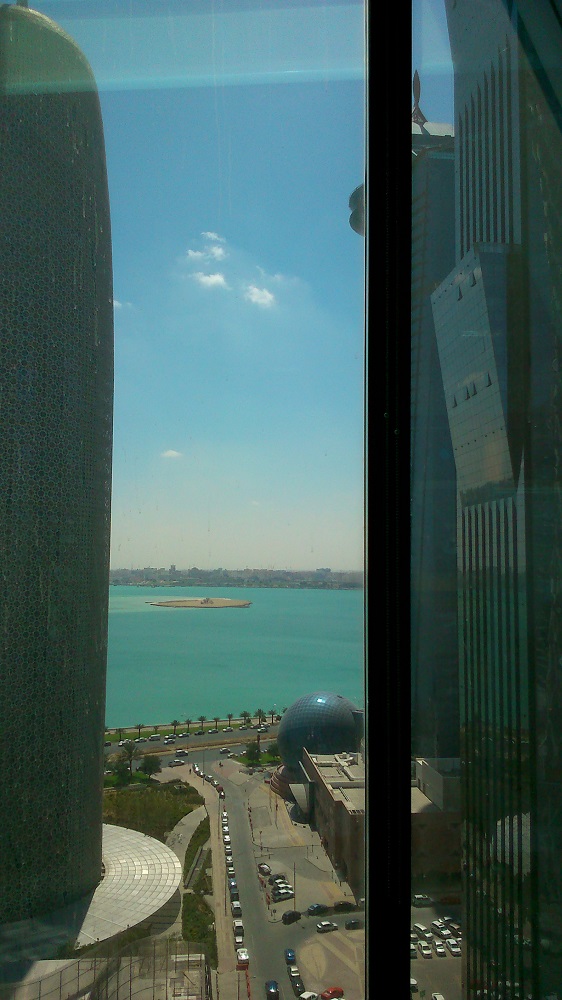
Greetings from Matteo Interlandi's office at Qatar Computing Research Institute
Pubblicati i voti delle prove del 19/02/2014
Si comunica agli studenti che sono stati pubblicati i voti delle prove di:
- Basi di Dati e Lab (Prova scritta del 19/02, prova laboratorio del 20/02)
- Tecnologia delle Basi di Dati
Per visionare il compito gli studenti possono presentarsi al ricevimento studenti Giovedì dalle 16.00 alle 18.00.
Per sostenere l'orale mandare una mail al docente per concordare la data.
Il presidente Obama chiede agli americani di imparare la computer science
Tesi su Big Data negli USA: gli studenti della laurea magistrale in Ingegneria Informatica Paolo Malavolta e Emanuele Charambalis svolgono la tesi magistrale su BIG DATA
Tesi su Big Data negli USA: gli studenti della laurea magistrale in Ingegneria Informatica Paolo Malavolta e Emanuele Charambalis svolgono la tesi magistrale su BIG DATA con tutoraggio congiunto della Professoressa Sonia Bergamaschi e del prof. H.V. Jagadish: (H V Jagadish Bernard A Galler Collegiate Professor Elec. Engg. and Computer Science. della University of Michigan) presso il Dipartimento di Ingegneria “Enzo Ferrari” dell’Università di Modena e Reggio Emilia e i presso l’Università del Michigan.
Si ringraziano gli sponsor, per la cifra di euro 2000 cadauno : ing. Ragni presidente dell'Associazione Specialisti di Sistemi Informativi di Bologna (assi-bo)
http://www.assi-bo.it/sites/default/files/2013-11-01%20TESI%20-%20Big%20Data.pdf
e l'ing. Orsini, presidente della spin-off UNIMORE DATARIVER http://www.datariver.it/it/datariver-big-data-negli-usa/.